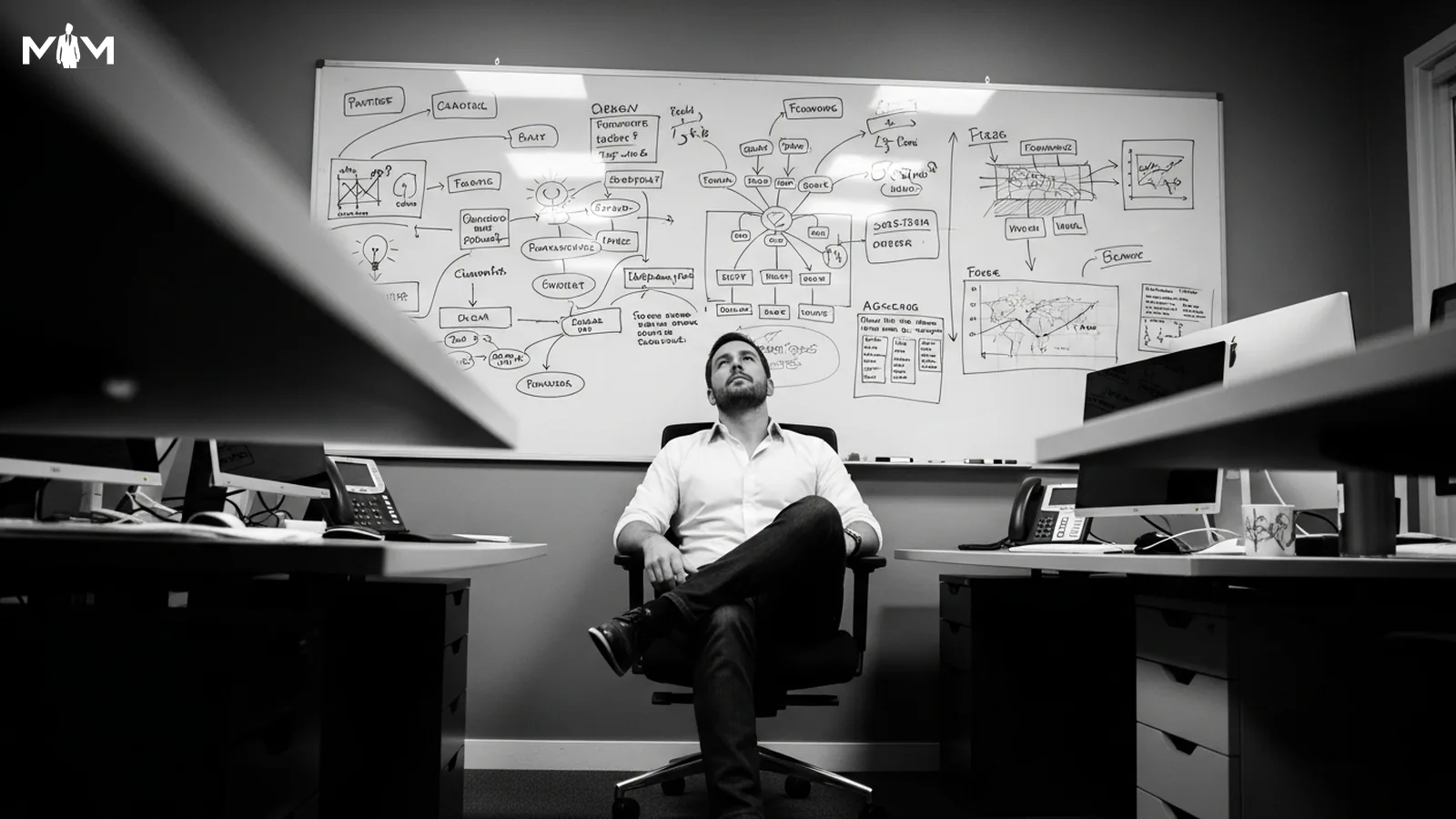
The tools you're evaluating this month were designed around constraints that won't exist in eighteen months. That's not hype. That's the actual problem with every AI decision you're making right now, and almost nobody is saying it out loud.
The Freeze Problem
Here's what most builders miss about current AI systems: they are fundamentally frozen. You train them, deploy them, and they stop learning. Whatever the world looked like on the day their training data was cut off, that's the world they live in forever. The next generation of AI systems will update their own weights during deployment, continuously, the way your brain does. Every experience reshaping the model in real time. That's not science fiction. That's the near-term engineering roadmap, and it changes everything downstream.
Why does this matter to you, right now, running a business that isn't an AI lab? Because you're building on infrastructure that has an expiration date baked in. The API you integrated last quarter, the workflow you automated, the chatbot you stood up, all of it was designed around the frozen-model paradigm. When that paradigm breaks, and it will, you'll be refactoring in a panic instead of ahead of the curve.
Trust the Watermark, Ignore the Output
At the same time, the industry is scrambling to solve a different problem: how do you tell what came from a machine? AI text watermarking schemes are getting sophisticated, embedding invisible signals in generated content so that downstream systems can detect provenance. On the surface this sounds like a content-authenticity problem. Authors, publishers, regulators trying to know what's real.
But if you're an operator, there's a more practical signal here. The very existence of watermarking infrastructure tells you the market is moving toward a world where the source of output matters as much as the output itself. Clients will eventually ask. Regulators will eventually require. If your business pipeline runs AI-generated anything and you don't have an answer for provenance, you're building a liability. Not today. Maybe not this year. But the scaffolding is being built around you right now.
The Antibiotic Parallel
This is where it gets interesting, and where a lot of smart founders zone out because the connection isn't obvious. Bear with us.
The FDA just finalized a new framework for evaluating antibiotic risk in animal agriculture, a framework that's been in development since 2022. Four years to formalize a risk-assessment model for a problem everyone already knew existed. The core issue with agricultural antibiotics isn't toxicity in the moment. It's resistance over time. You feed low doses to animals for years, the bacteria adapt, and eventually the drugs stop working when you actually need them. The harm is deferred, systemic and not visible until it's serious.
That is exactly the shape of the risk you're running with today's AI integrations. Not that the tool breaks today. That you build your processes around its current limitations, your team adapts to working around its blind spots, your clients get used to its outputs, and then the model shifts. Continuous-learning models don't fail gracefully. They drift. They update. The thing you calibrated against is no longer the thing you're running.
The FDA took four years to build a framework for deferred, systemic risk. You don't have four years. But you do need a framework, even a rough one, for auditing which parts of your stack are load-bearing versus experimental. Which workflows would break if the underlying model changed its behavior next Tuesday? That list is your actual risk register.
The Long Time Horizon Nobody Runs
There's a land-art installation in New Mexico that took half a century to complete and is designed to help viewers perceive 13,000 years of time in a single glance. You can argue about whether that's art or philosophy or both. What we can't argue is that almost nobody in technology is operating on anything close to that timescale. Most founders are optimizing for the next sprint, the next funding round, the next quarter.
That's appropriate most of the time. But when the underlying infrastructure is changing this fast, short-horizon thinking becomes the mistake. The founders who are going to win the next three years aren't the ones who adopted AI fastest. They're the ones who built their adoption strategy around the assumption that what they're adopting will change, substantially, on a timeline they can't control.
What David Baszucki Got Right
Roblox became what it is by making a specific bet: give people tools and incentives to create together, then get out of the way. Baszucki talks about fixing your own decision-making before trying to fix your systems, and the core of that is a kind of epistemic humility. You have to be willing to hold your current model of reality lightly enough that new information can update it.
That's exactly the muscle you need right now. Not certainty about which AI tools will win. Not a fully locked architecture. The ability to make a provisional decision, ship something real, then update your priors when the landscape shifts. The founders getting hurt right now aren't the ones who moved too slowly. They're the ones who moved fast and then refused to revisit the decision when the underlying assumptions changed.
What This Means Practically
We build a lot of AI-adjacent systems for clients in music, health, agriculture and creative industries. What we've learned to ask before we touch any of it: what happens to this workflow if the model underneath it changes its behavior by twenty percent? What happens if the API changes its pricing structure? What happens when a continuous-learning version hits the market and outputs become non-deterministic in ways they weren't before?
If the answer is "we'd have to rebuild from scratch," that's a design failure, not a technology failure. The architecture should absorb model-level drift the way a good building absorbs wind. Not rigid. Resilient.
Practically, that means a few things. Keep your data layer yours, not the model vendor's. Build workflows where AI is a step, not the spine. Design for the output being auditable, even if that audit is manual right now. And treat every AI integration as a dependency with an unknown upgrade schedule, because that's exactly what it is.
The founders who will look smart in 2027 aren't the ones with the flashiest AI stack today. They're the ones who treated AI like what it actually is: powerful but unsettled infrastructure in the middle of a generational shift, worth using carefully, worth building around with your eyes open.
The tools are changing. Your job is to make sure your business isn't the thing that breaks when they do.