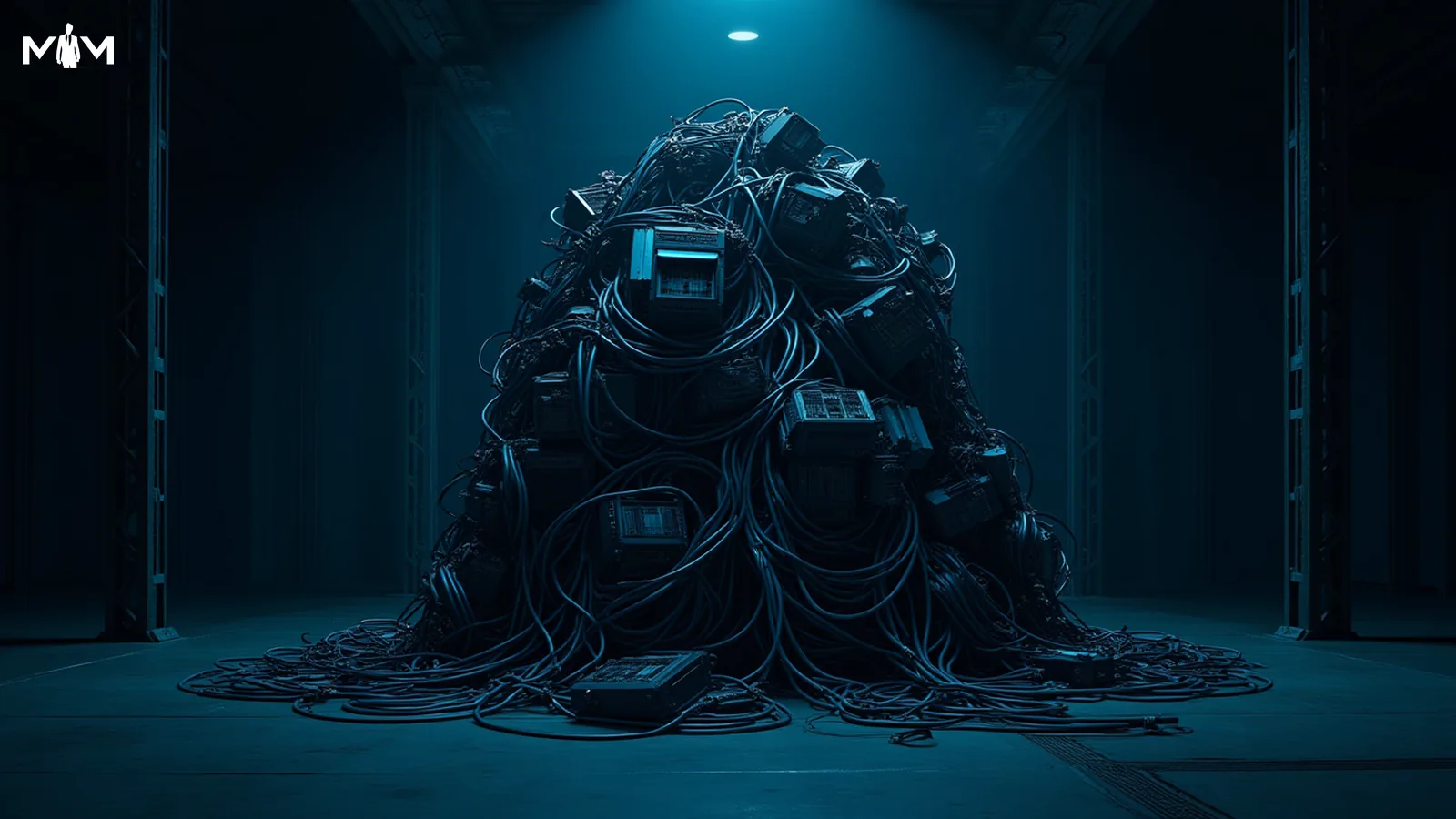
Software eats the world, sure. But it also piles up like unread mail. Nobody plans for the pile. That's the pattern we keep watching, across decades and across domains, and it's accelerating right now in a way that should make any founder building on the web sit up straight.
622 Is Not a Number. It's a Diagnosis.
Microsoft just shipped its largest Patch Tuesday on record, closing 622 of its own security flaws in a single release. Triple the previous high. Two of them were already being exploited in the wild before the fix landed. Think about what that number actually represents: hundreds of separate moments where complexity quietly outran intention. Where something was added, something else was assumed, and nobody noticed the gap until an attacker did.
This isn't a Microsoft problem. This is what happens to every system that grows without corresponding discipline. Features arrive. Abstractions stack. Years pass. The surface area expands in every direction and the people who understood the original architecture are long gone. What's left is an organism nobody fully understands anymore.
Jaron Lanier Saw It Coming in 1986
Forty years ago, a 26-year-old Jaron Lanier was already naming the core trouble. In a 1986 interview that resurfaced recently, the person who would later help define virtual reality argued that programming forces the brain into a kind of unnatural contortion. We are not wired for the rigor that software demands. We miss things. We hold simplified mental models and treat them as complete. The complexity accumulates beneath the model, invisible until it isn't.
His insight wasn't pessimistic. It was practical. The difficulty isn't that programmers are bad at their jobs. It's that the job is inherently adversarial to how human cognition works. We think in patterns. We fill gaps with assumptions. Software punishes every one of those assumptions eventually. The older the codebase, the more assumptions are buried in it, and the higher the cost when one of them fails.
Personalization Is the Same Problem Wearing Different Clothes
Google just revamped image search to build a personalized, always-updating gallery shaped around each user's "unique interests." More images. More AI. More signals being tracked, weighted, fed back into the loop. It's presented as a feature. From another angle, it's a system growing new surface area in a direction that's hard to audit and harder to predict.
For you, the founder, here's the relevant question: your customers now live inside personalized information environments that are getting more personalized every month. What worked to reach them last year may not work next year, not because you did anything wrong, but because the landscape underneath them quietly shifted. Accumulation again, just on the demand side this time.
The Artist Who Refuses to Accumulate
Here's the counterforce, and it's the thing worth holding onto. A California landscape artist is thru-hiking the Pacific Crest Trail right now, painting one picture a day. He stops, looks at what's in front of him, and paints it. That's the whole system. Nothing accretes. No technical debt. No compatibility backlog. Each painting is finished and complete before the next one starts.
We are not saying you should run your business like a hike. We are saying that the painter has something the 622-patch release does not: a forcing function for completion. He can't carry yesterday's unfinished canvases up the mountain. He has to ship. That constraint is not a limitation. It's what keeps the work clean.
Your Stack Is Accreting Right Now
Most of the founders we talk to are sitting on exactly this problem. A web app built in a rush three years ago. Integrations added one by one as the business needed them. A login system that was "good enough" at launch. A database schema that made sense for version one. None of it is catastrophically broken. All of it is quietly accumulating surface area, and nobody has time to deal with it because the business keeps moving.
Research on developing brains suggests that early pattern formation has outsized consequences for later behavior, that how a young nervous system learns to process signals shapes the whole downstream architecture in ways that become very hard to rewire. Codebases work the same way. The patterns you locked in at the start, the shortcuts taken when you had no users and no money, those become the foundation everything else is built on. They don't get less important as you scale. They get more important, because every new piece is resting on them.
What You Can Actually Do About It
The problem with accumulation is that it doesn't feel like a crisis. It feels like normal. One more dependency. One more open port. One more edge case handled with a conditional buried somewhere in a function nobody opens anymore. Until the day it doesn't feel normal. Until the day it feels like 622 patches and two zero-days already in the wild.
The move is not a full rewrite. The move is a periodic forcing function. Pick a date, every six months works for most teams at your stage, and spend two days doing nothing but asking: what is actually running in our stack right now? What does it touch? What touches it? Where did we take a shortcut we never closed? You are not looking for a disaster. You are looking for the small accumulations before they compound into one.
We have done this audit for founders who were certain their stack was fine. We have never once come back empty-handed. Not once in 25 years.
Complexity Is Neutral. Unexamined Complexity Is Not.
Lanier's point from 1986 was never that software is bad. It was that software demands more honest self-examination than most humans naturally give it. The systems that fail, whether they're codebases, platforms, or businesses, don't fail because someone was malicious. They fail because the gap between the mental model and the actual system grew too wide for too long with nobody looking.
You can't stop your stack from growing. You can decide to keep looking at it. That decision, made regularly, deliberately, before the crisis, is the only thing that separates the companies that hit 622-patch territory from the ones that don't.
The mountain doesn't care how many unfinished paintings you're carrying. Sooner or later, you have to set them down.