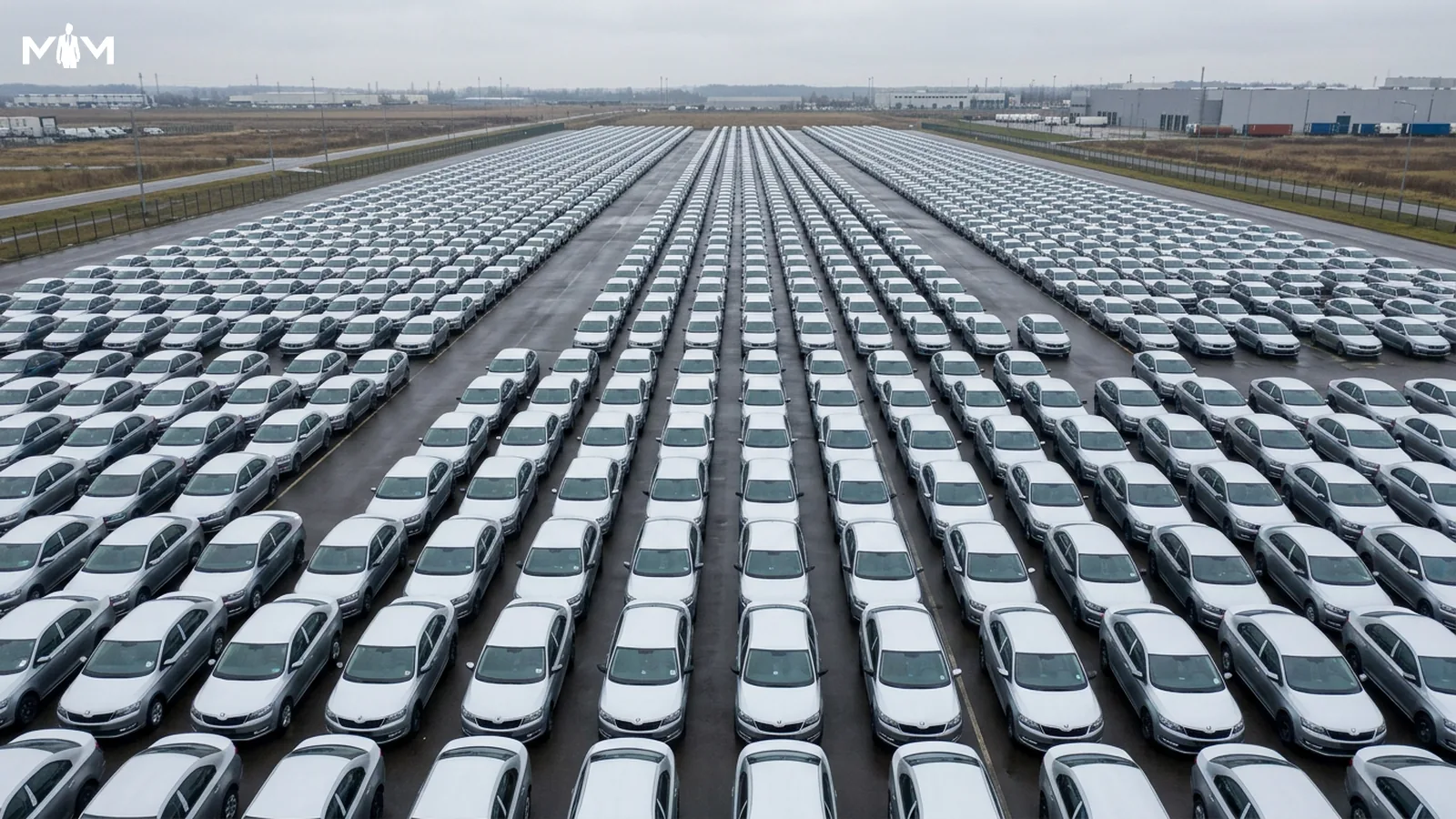
There is a concept in manufacturing called "work in progress inventory," and it is quietly one of the most dangerous things you can accumulate in a business. It looks like progress. It is actually exposure. The stuff you built but haven't delivered, the decisions you made but haven't acted on, the systems you launched but never validated — that's all inventory. And carrying too much of it is a form of debt that doesn't show up on your balance sheet until it collapses on top of you.
Three very different things happened this week that are all the same story.
Lucid cut production by 38% in Q3 — on purpose. The new CEO looked at the cars sitting unsold on lots and said: before we build more, we deliver what we have. That sounds obvious. It almost never happens. What almost always happens instead is the team keeps building because building feels productive, because the machinery is already running, because stopping to clear the backlog feels like retreat. Lucid spent the first half of 2026 stacking inventory nobody bought. Q3 was the first quarter they delivered more than they produced. That's not a metric. That's a philosophy shift.
Across the country, farmers are watching federal support for on-farm solar get gutted by USDA rule changes that could effectively end the REAP program for renewable energy. Farmers who planned investments around a funding structure that existed last year are now holding infrastructure commitments against a policy environment that moved without warning. That's inventory risk of a different kind: you can pile up dependencies on systems you don't control, and when those systems shift, you're the one left holding the exposure.
Meanwhile, in the AI world, the conversation has moved somewhere that should make you pay very close attention. MIT Technology Review reports that the frontier has shifted from whether AI can predict accurately to whether it can act on those predictions autonomously without drifting from business intent. In other words: the model is no longer the hard part. The inventory of accumulated business decisions the model is supposed to reflect — that's the hard part. An agent that acts on stale intent is worse than no agent at all. It's a machine executing your old assumptions at scale.
And then there's this: mathematicians are genuinely afraid that AI will make their profession obsolete, and the sharpest voices in that conversation are not the ones saying "we'll be fine." They're the ones saying "if we don't adapt, there's just no more math in 50 years." What makes that striking isn't the fear. It's the recognition that even deeply validated expertise accumulates into something that can become a liability. A lifetime of methodology, if it doesn't get stress-tested against a new reality, becomes inventory nobody can move.
Here is the thread: every scaling operation, whether it's a car company, a farm, an AI system, or a discipline that's been around for centuries, eventually reaches a moment where what it has built outpaces what it can actually use. The pipeline gets ahead of demand. The assumptions get ahead of reality. The production gets ahead of delivery. And the organizations that survive that moment are the ones that stop, look at what's sitting unsold, and deliberately clear the backlog before building more.
We see this constantly. A founder comes to us at $2M or $3M in revenue and the business is technically working, but it's slow, it's chaotic, it's burning the team. We start asking questions. What are you building right now that's not yet in the hands of a customer? What decisions did you make eighteen months ago that are still shaping how you operate, even though the market has changed? What tools, workflows, and automations are you running that were designed for the version of your business that existed before it started working? That's the inventory. And most of the time it's enormous.
The instinct when you hit a scaling wall is to add. More engineers. More tools. More features. More automation. But even in AI research, calibration matters as much as prediction quality — the right answer delivered with the wrong confidence level is still the wrong answer. You can't just stack more output on a foundation of unvalidated assumptions. The benchmark for good decision systems isn't raw accuracy. It's calibration: knowing what you know, knowing what you don't, and building in the right level of caution for each.
That's the discipline Lucid's new CEO is applying to a car company. That's what the farmers who built solar infrastructure on top of stable policy assumptions didn't get to do. That's what the AI teams building autonomous agents are being forced to confront right now. And that's what we think most founders at $1M to $5M in revenue are not doing, because they are too busy building to stop and audit what they've already built.
So here is the thing we'd tell you if you were sitting across from us right now: your next hire might not be a builder. It might be someone who looks at everything you've already built and asks what's actually getting used, what's working as designed, and what's just sitting there accumulating carrying costs. Your next sprint might not be a feature sprint. It might be a clearance sprint, where you get honest about the inventory, stop producing more of it, and don't start again until the backlog is real and lean.
The businesses that survive the jump from scrappy to scalable are not the ones that built the most. They're the ones that cleared their backlog before their competitors noticed they had one.
If you're not sure what's sitting on your lot, that's the first thing we'd want to figure out together.