There is a pattern running through things that look completely unrelated right now, and it is worth your time to see it clearly. A modder spending years improving a two-decade-old game engine. Apple running its iPhone release calendar like a Swiss train schedule. Streaming platforms quietly herding everyone back toward the ad-supported tier. A hardware reviewer praising a gaming PC for its cooling system. These things seem like noise. They are not.
The thread connecting all of them is this: in every market, a gap is opening between the product people will put up with and the product they will pay a premium to keep. The companies, creators and operators who understand that gap are going to own their category. The ones who don't are going to find themselves on the wrong side of a paywall they didn't build.
The Streaming Lesson Nobody Is Applying
When streaming launched, the whole value proposition was relief. No commercials, no cable bundles, no 47 channels of garbage. That reprieve is now gone for most subscribers. The platforms needed ad revenue, so they introduced ad-supported tiers, and then they slowly made the ad-free experience the premium exception rather than the baseline. What started as the default product became a luxury SKU.
Most people read this as a streaming story. We read it as a business architecture story. The platforms discovered that the absence of friction is a product feature people will pay to preserve. They are now monetizing the removal of something they added back in on purpose. That is a dark pattern, and it works, which is exactly why you need to understand it even if you'd never run it yourself.
The honest version of this lesson for an independent operator is cleaner and more ethical: the distance between your baseline experience and your premium experience needs to be felt. If your clients can't articulate what they're getting for the upgrade, they won't upgrade. And if your free or entry tier is painless enough, they'll never see the reason to move.
Predictability Is the Product
Apple does not make the best smartphone in any single technical dimension. They make the most predictable smartphone ecosystem on the planet. The fact that a developer beta release is now considered reliable evidence for a September launch date tells you everything. The calendar is so consistent, so trustworthy, that analysts can reverse-engineer a hardware announcement from a software build number. That predictability is worth billions. People buy into Apple's world partly because they know what they're getting and when.
We work with founders running businesses at $1M to $5M who are operationally chaotic and technically brilliant at their core craft. They are usually not predictable. They deliver great work when they deliver it, their timelines slip, their invoicing is inconsistent, their communication is patchy. The work itself is often better than anything a larger shop would produce. But the experience of working with them is unpredictable, and that unpredictability caps their pricing power hard.
Predictability is a premium feature. It is not a personality trait. It is an operational system. Apple has it because they built it, not because Tim Cook is a more organized person than your average founder.
The Modder Knows Something the Product Manager Doesn't
Here is the part that surprises people. Someone is spending serious engineering hours improving a game that shipped twenty years ago. Not remaking it. Not wrapping it in nostalgia. Actually going into the guts of old code and making it better than the original team left it. Why does that happen? Because the core experience was good enough to be worth preserving, and the community valued it enough to fund the effort with their time.
There is a business principle buried in here that most founders miss. The products and services that attract modders, advocates and obsessives are not the most polished ones. They are the ones with the most honest core value. They do one thing in a way that feels irreplaceable. Everything else is surface. You can sand the surface forever, but if the core is hollow, nobody is staying up late to fix your deprecated codebase.
When we audit a client's product or service offering, one of the first questions we ask is: what is the thing people would miss so badly they'd try to rebuild it themselves if you disappeared? If they can't answer that question in ten seconds, that's the problem. Not the marketing, not the pricing, not the funnel. The core.
Ergonomics Are Not a Bonus Feature
The reason MSI's handheld PC is drawing serious attention comes down to ergonomics and thermal management. Not the processor. Not the screen resolution. The way it sits in your hands and the way it handles heat. In a category full of capable hardware, the thing that wins is how it feels to use for four hours. The baseline performance is now table stakes. The differentiation is in the sustained experience.
We see this constantly in software products and client-service businesses alike. The features are roughly equivalent across competitors. What isn't equivalent is the experience of using the product or working with the team over a long engagement. The onboarding. The communication cadence. The moment something goes wrong and you find out whether the shop panics or handles it. Those are your ergonomics. They are not soft, feel-good extras. They are the actual product at $1M and above, where the buyers have been burned before and they're paying for confidence as much as capability.
What This Means for Your Business Right Now
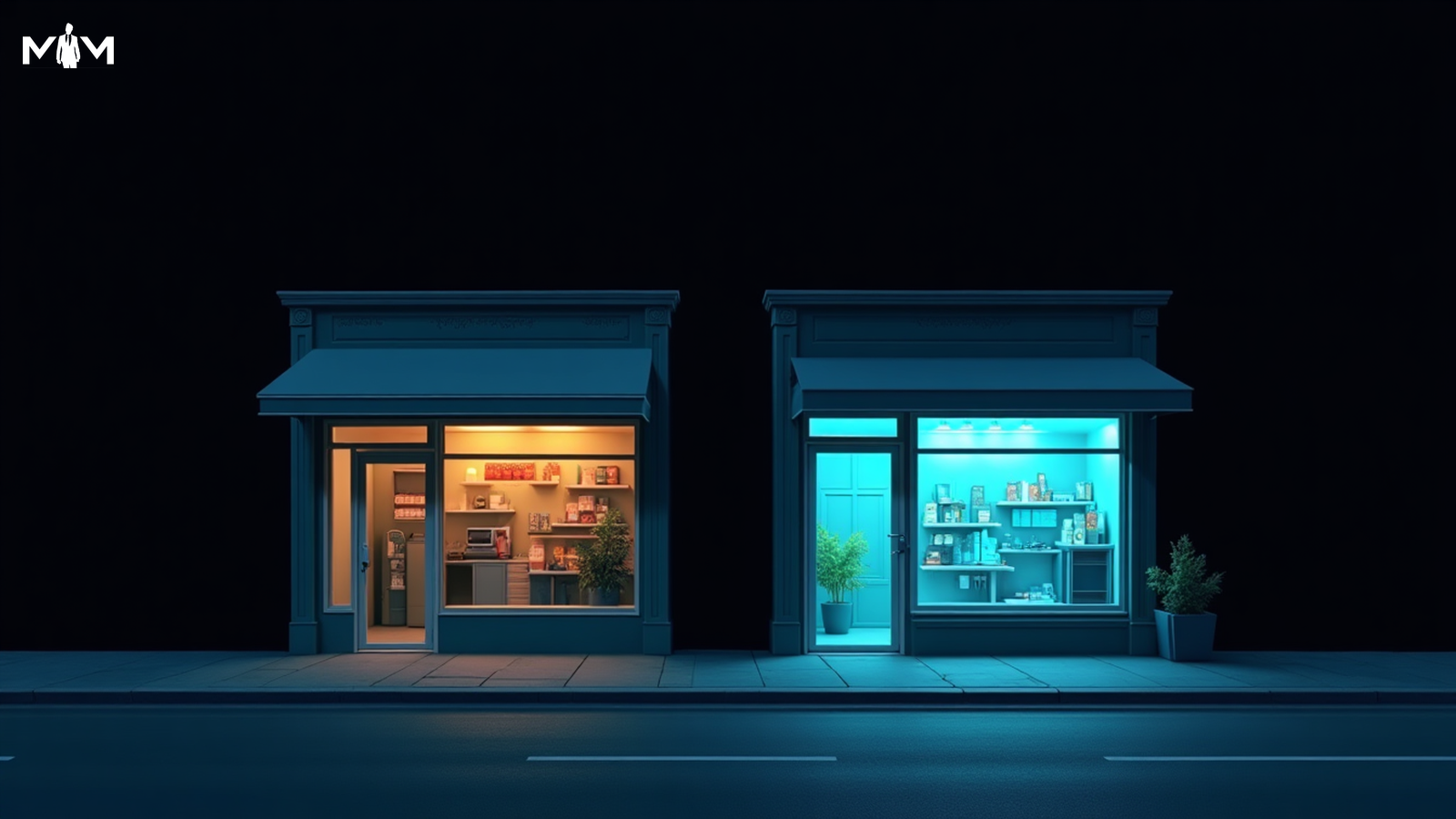
These four signals are pointing at the same thing. Every market is quietly bifurcating. There is a tier where you tolerate the friction because the price is low enough, and there is a tier where you pay to make the friction disappear. The middle, where things are neither cheap enough to dismiss nor good enough to love, is being hollowed out.
If your business lives in the middle right now, you are not safe. You are in the zone that is getting squeezed from both ends. The no-frills competitor is getting good enough on quality. The premium competitor is getting aggressive on justifying their price. The operators we see thriving are the ones who have made a deliberate choice: own the premium experience in their niche, or own the efficient volume play. Both are valid. Neither is the mushy middle.
Owning the premium experience does not mean charging more for the same thing. It means building the operational layer that makes your clients feel like Apple users: everything arrives when it's supposed to, nothing breaks without a plan, the experience is consistent enough that they stop thinking about it as a risk. It means knowing what your core value actually is and protecting it the way a modder protects a game they love. It means understanding that the thing people will pay to keep is never the feature list. It is the feeling that this thing was built by someone who gave a damn.
We have spent 25 years watching businesses stall at exactly the point where that operational layer should have been built and wasn't. The founders who get through it are the ones who treat predictability, core value and sustained experience as engineering problems, not personality challenges. If you're running into that wall right now, that's not bad luck. That's the gap calling for a system.